
Macrocycle
The broadest block. It organises the major periods of the season (for example, preseason and the first half of the league) and gives them a working direction.
Each team has its methodology for the season: macrocycles, mesocycles and microcycles with their dates, the tactical objectives of each week and the planned session plans. A panel then shows how the real work was distributed across phases and zones, and flags when part of the game is not being trained enough.
Included in the Coach, Coach Pro and Club plans
Methodology does not have to live in a document created at the start of the season and forgotten afterwards. In NeoTactIQ each team has one methodology per season, with start and end dates, organised into three connected levels.
Each training event is automatically assigned to its microcycle according to its date and, through that structure, to the corresponding mesocycle and macrocycle. The hierarchy stays intact without manual reclassification.
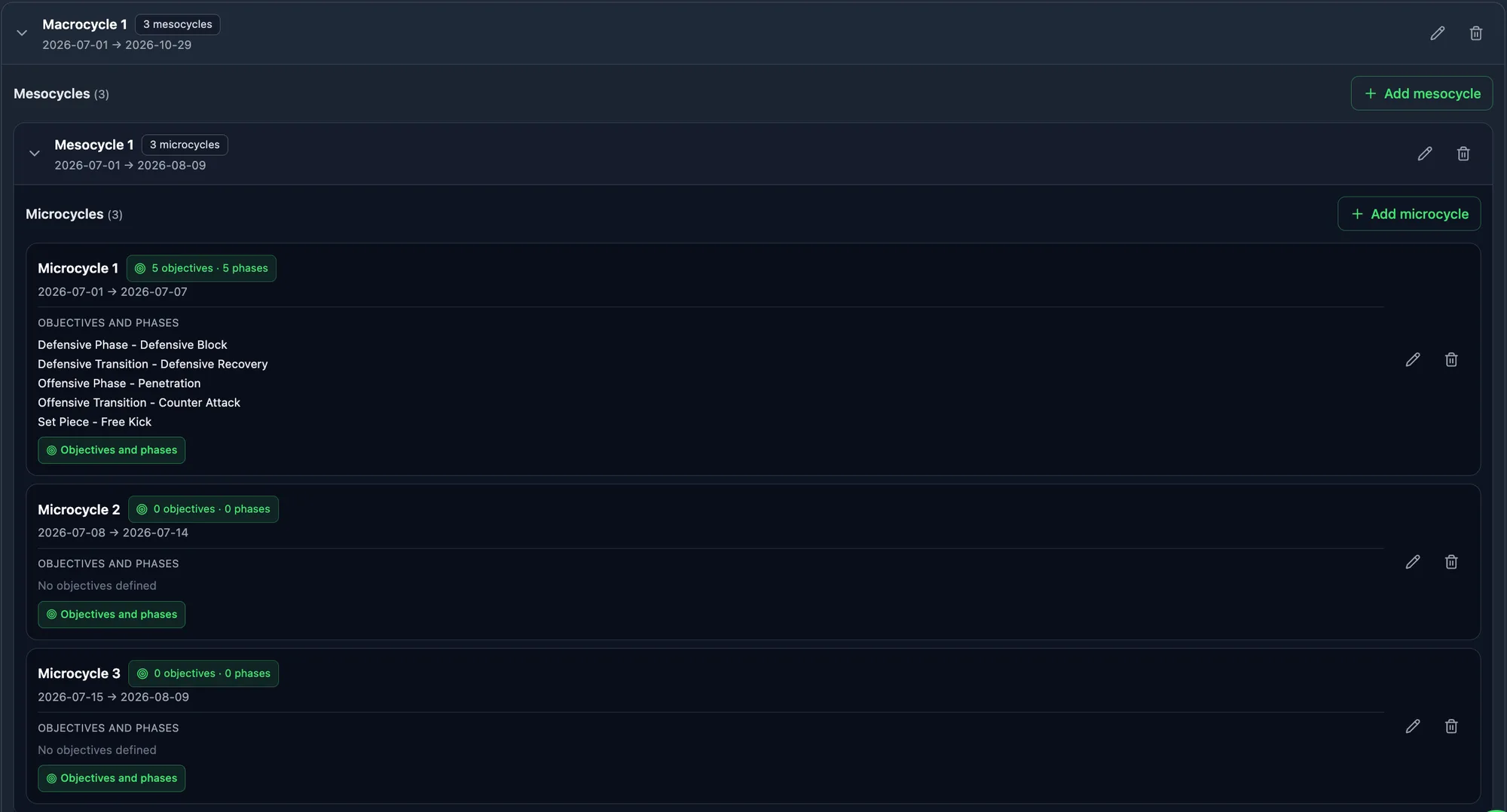
The broadest block. It organises the major periods of the season (for example, preseason and the first half of the league) and gives them a working direction.
Breaks the macrocycle into more focused blocks so you can review a period without reducing everything to isolated training days.
Takes planning into the weekly context: the objectives you want to prioritise and the session plans you will use over the coming days.
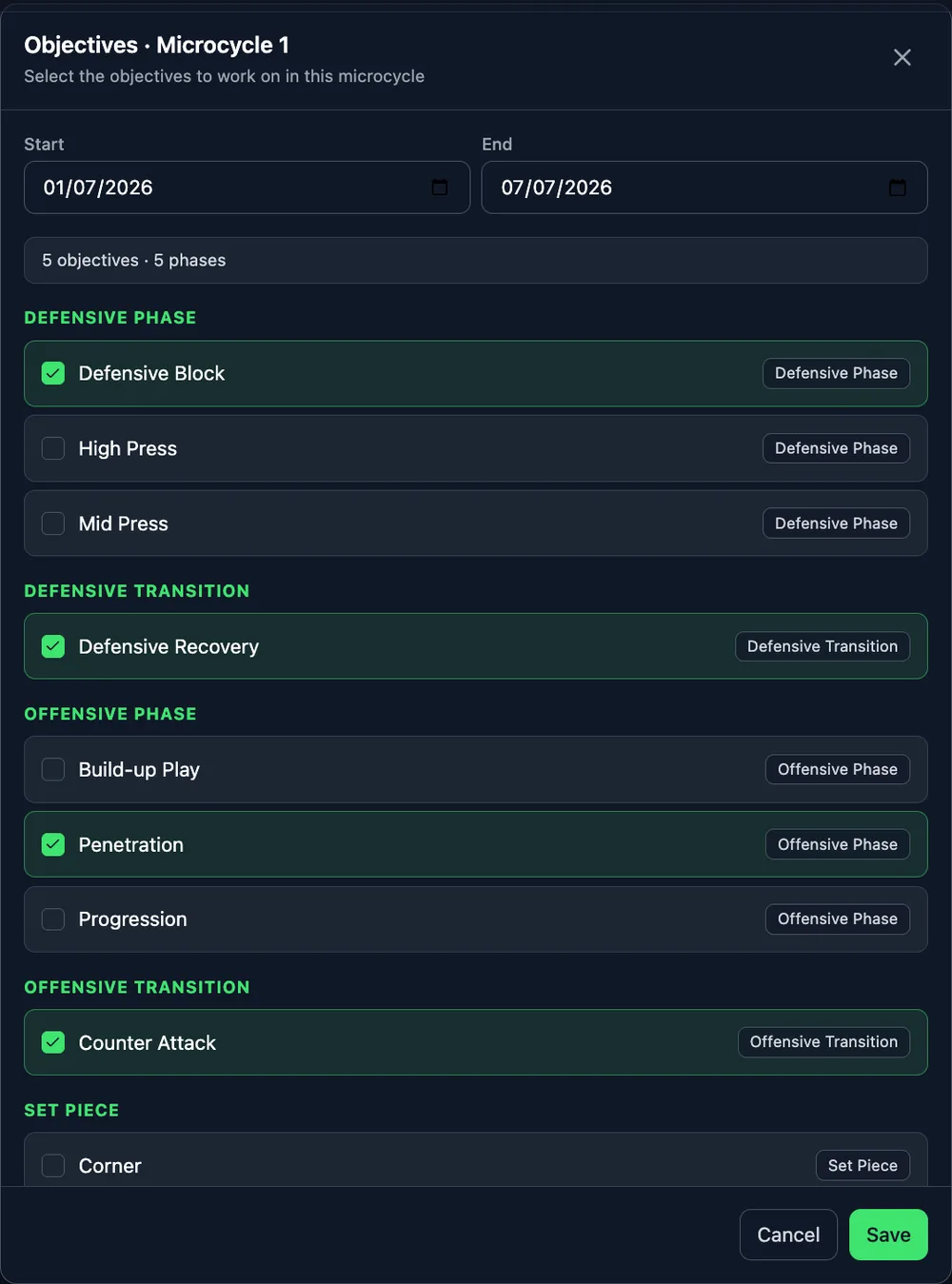
A microcycle is more than a container for dates. It lets you write down the priorities of the week before the work begins.
Objectives come from a catalogue of 31 tactical contents grouped into five families: attacking organisation, defensive organisation, defence-to-attack transition, attack-to-defence transition and set pieces. For example, “Attacking organisation · Build-up play” or “Attack-to-defence transition · Counter-pressing”.
You move from a broad intention — reinforcing counter-pressing during the week — to training events that remain inside the same framework. The coach still makes every football decision: the platform does not plan for you, it preserves the structure so you can later review whether the work carried out matched the original intention.
Each microcycle can have the week’s session plans assigned from your library. Planning stops being a list of objectives and gets concrete content: which session runs on Tuesday, which on Thursday.
When the day arrives, you link that session plan to the training event and the record keeps what was actually done.
The difference is not in writing more objectives but in being able to return to them as the season develops. The Methodology panel crosses the four phases of the game (attacking and defensive organisation, plus both transitions) with the three pitch zones (build-up, creation and finishing), showing how many training events and what share of the work each combination has received.
NeoTactIQ also suggests a balance recommendation when a zone falls short. A real example: “In ‘Attack-to-defence transition’, the ‘Build-up zone’ only has 17% of the work (expected ~33%). Reinforcing this zone will improve tactical consistency.”
The recommendation does not replace your judgement: it points to where it is worth looking before you build the next microcycle.
Shows how work is distributed across phases and zones and flags imbalances.
When you close the match report, the staff sets 1 to 3 objectives for the following week. Those objectives are suggested in the next microcycle of the methodology, so what you saw on Sunday directly shapes what you train on Tuesday.
You accept, adjust or discard the suggestion: the decision stays with you. Match reports are included in Coach Pro and Club.
When you coordinate several teams, asking what each coach intended to do is not enough. You need comparable blocks and a clear view of what was actually recorded.
Mesocycles provide a useful scale for that review. You can look at specific periods, see how work is distributed across phases and zones for each team, and keep methodological conversations grounded in evidence from the system itself.
This does not replace coaching judgement or technical discussion. It gives coordination and coaching staff a shared framework for talking about the same work.
Coordinate with evidence, not by chasing files.
No. If you organise work by weeks, you are already using a microcycle logic even if you do not call it that. NeoTactIQ writes that structure down and connects it with training so it can be reviewed later.
Objectives from a catalogue of 31 tactical contents in five families (attacking and defensive organisation, both transitions and set pieces) and the week’s session plans from your library.
Each training event is automatically assigned to its microcycle according to its date. That microcycle belongs to the relevant mesocycle and macrocycle.
Yes. The panel shows the number of training events and the share of work by phase and zone, and suggests a recommendation when a zone falls below what is expected. The decision on how to adjust future planning remains with the coach.
Yes. The 1 to 3 objectives you set when closing the match report are suggested in the next microcycle. Match reports are included in Coach Pro and Club.
If you are a coach, organise your next cycles, assign the week’s session plans and keep each training event inside its context.
If you coordinate several teams and need to review blocks of work inside one shared structure, we can show you how NeoTactIQ fits your methodology.
Included in the Coach, Coach Pro and Club plans