Facilities and schedules
Pitches split into halves and quarters, rooms and an automatic generator for the weekly schedule that respects each team’s needs. Bookings with rules and holidays that close facilities.
Turn the daily work of every team into information for running the club. NeoTactIQ brings together sporting structure, seasons, methodology, statistics, reports, scouting and club operations so decisions do not depend only on conversations, scattered files or what one person happens to remember.
A sporting director needs context to make decisions. Remembering who played well last month or rebuilding a season from separate conversations is not enough.
In NeoTactIQ, activity recorded by teams as part of their daily work remains available inside the same environment. Matches feed consultable statistics, while player tracking can preserve operational information such as minutes, events and recorded development.
The platform does not decide a contract renewal, promotion or signing. Coaches write individual reports with the period’s data already filled in — call-ups, minutes, goals, training attendance — but the assessment and the decision remain with the club. The value is that the conversation can begin with data that already belongs to it.
You can review the relevant team's information and use it alongside the knowledge of coaches, coordinators and sporting management. The decision remains human; the context no longer has to be rebuilt in a spreadsheet before every meeting.
Every summer changes the structure. Players leave, coaches move on and age groups begin again. If the previous season's knowledge lives in personal folders, the club loses context precisely when it needs to use it.
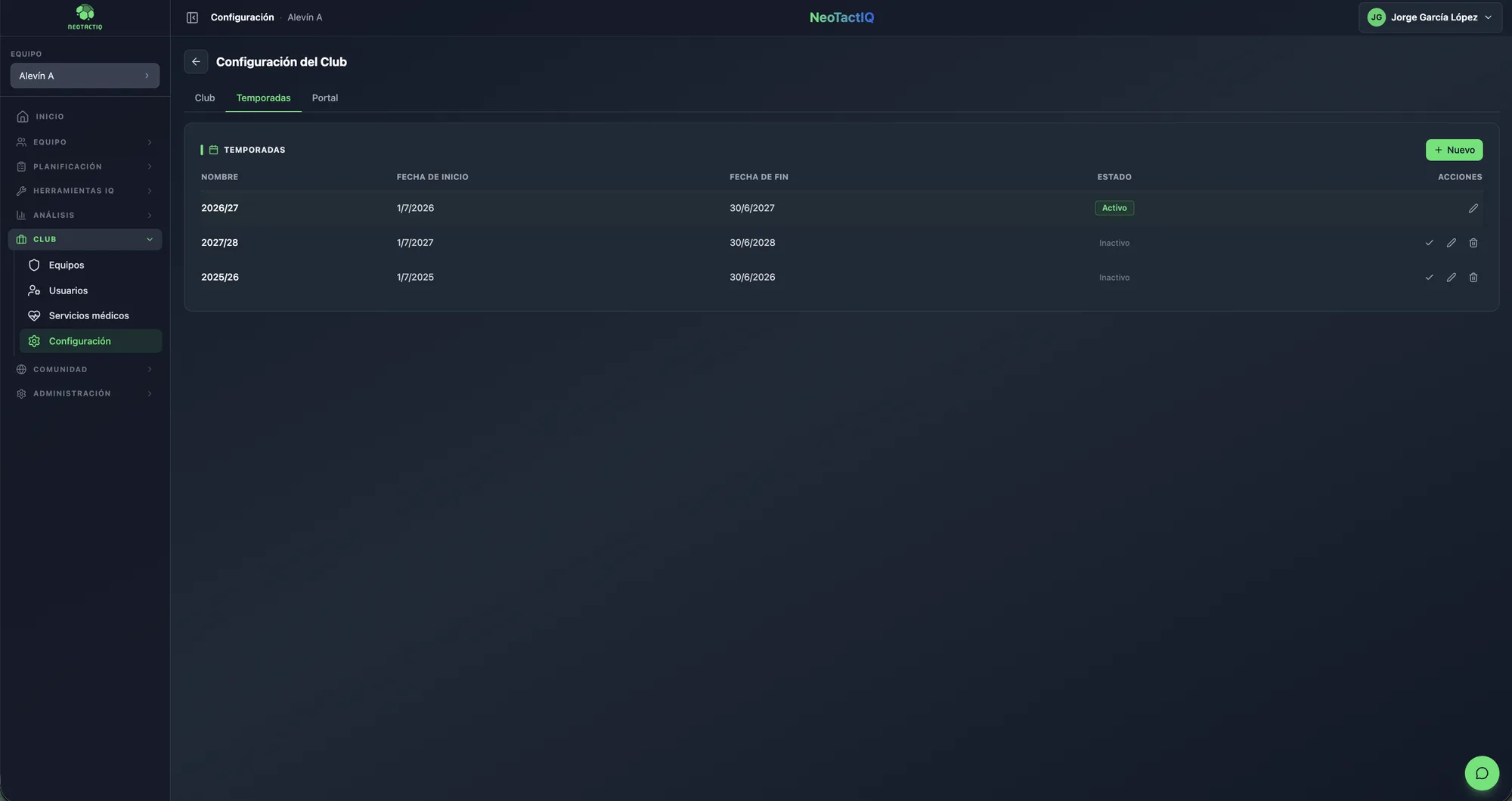
NeoTactIQ lets you close seasons and preserve them as history.
The point is not to promise which exact data point will remain forever. It is to preserve the season as part of the club's institutional journey. Changes in personnel therefore do not require the organisation to reconstruct everything it had already built.
Close the season and keep the history: the club does not start from zero every year.
The individual report adapts to the player’s stage — foundation (up to 12), development (13 to 16) and performance (17 and over) — and rates each block (tactical, psychological, technical, physical, social and attitude) against what is expected for that stage, never against teammates.
For continuity and promotion decisions, the report shows the birth quarter and flags the relative age effect: do not mistake physical maturity for talent. From age 13, players can add their own self-assessment, and the report history follows the player from one season to the next.
Each team’s period report sums up the month, half-season or season: home and away record, goals by time band and origin, the average rating for each phase of play and how minutes were shared. Reports are included in Coach Pro and Club.
Assess against the stage, not against teammates, and without mistaking physical maturity for talent.
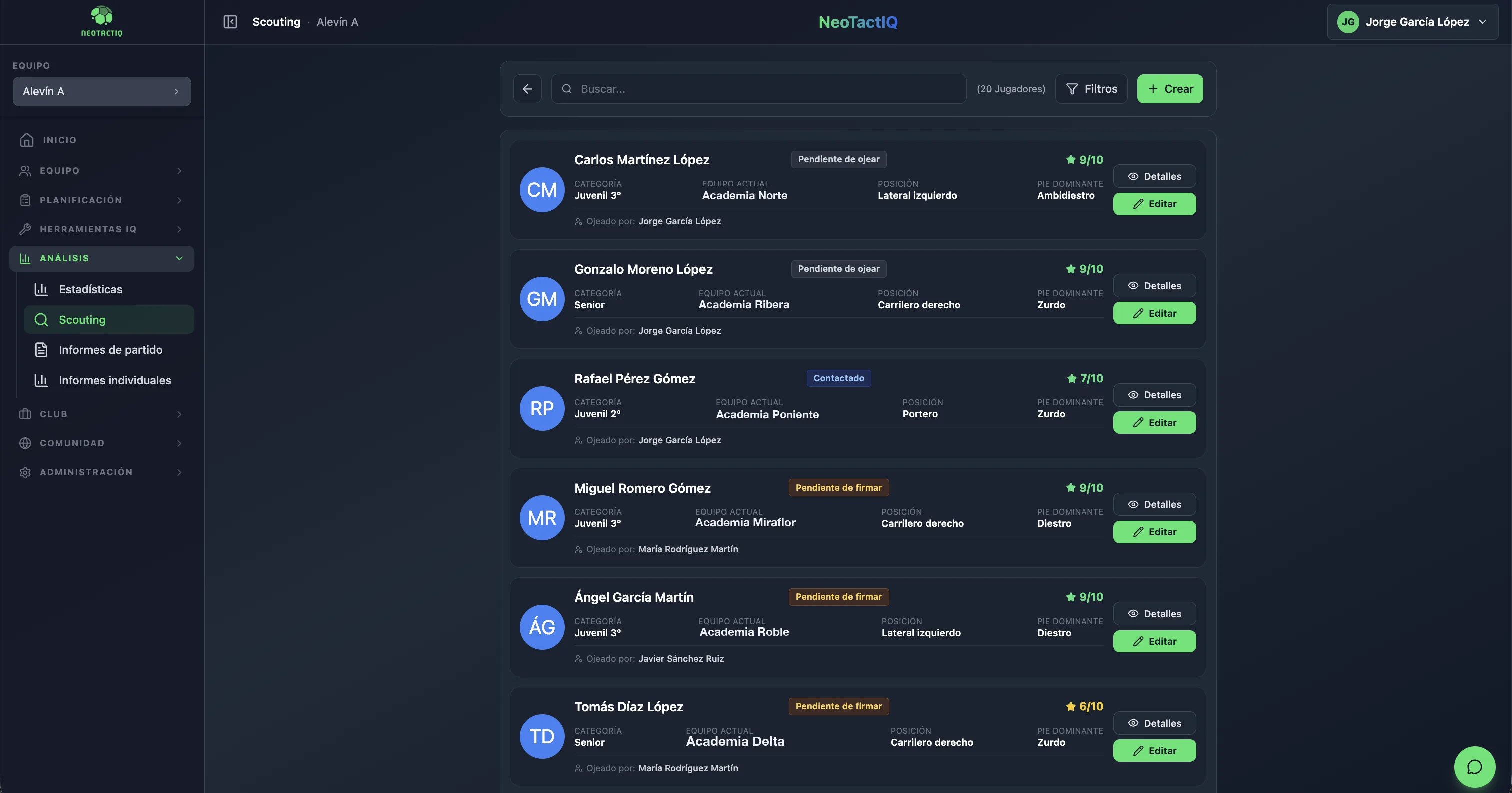
Scouting loses value when the follow-up exists only in the notebook, phone or memory of the person who watched the player.
NeoTactIQ keeps tracked players in a recruitment pipeline with stages — from new, pending scouting and scouted to contacted, on trial, pending signature, signed or discarded — with a rating out of 10, family and agent details and the “scouted by” reference that identifies who contributed each observation.
For sporting management, the value is institutional: knowledge about a player does not disappear when a scout or recruitment staff member changes. The player's profile and follow-up remain inside the club environment.
That makes recruitment easier to supervise without turning it into a collection of personal files or claiming that the system makes automatic signing decisions.
Scouting stops living in the scout's notebook.
Many organisations have a written football philosophy. The problem comes when that document is separate from what teams actually work on every week.
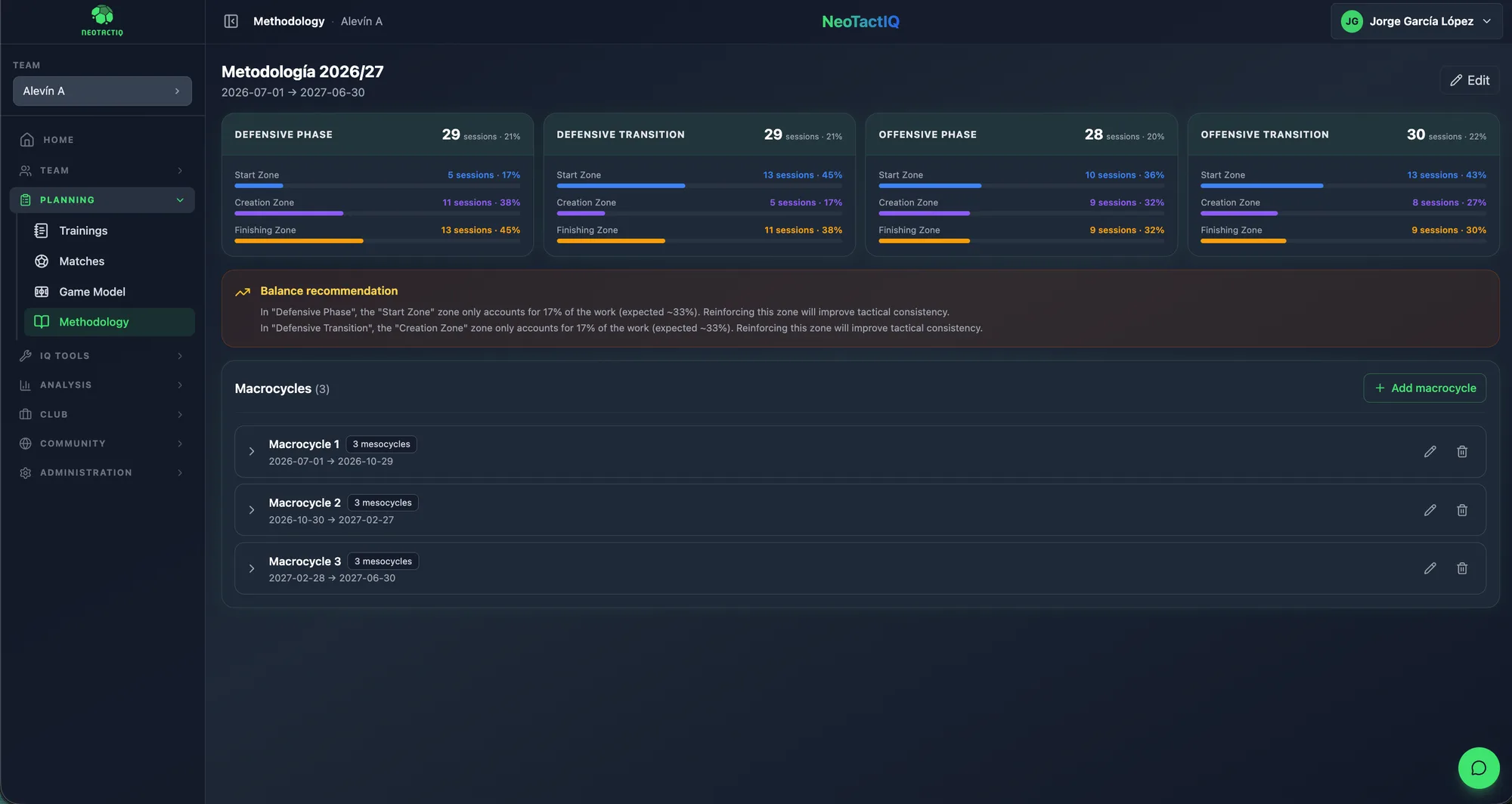
In NeoTactIQ every team works in the same language: the same phases of play, tactical objectives, pitch zones and drill classification. Each team has its season methodology, with macrocycles, mesocycles and microcycles, and each microcycle records its content.
The platform shows how work is distributed across phases and zones and detects imbalances. Sporting management can therefore review a team’s methodological context without reducing supervision to a vague conversation about whether “the club idea is being followed”.
This does not mean imposing the same football on every coaching staff. It means the club’s idea no longer has to remain an isolated PDF and can be read in what is actually trained.
With the Club plan, the work that does not happen on the pitch is organised too:
Pitches split into halves and quarters, rooms and an automatic generator for the weekly schedule that respects each team’s needs. Bookings with rules and holidays that close facilities.
Inventory with minimum stock, loans and kits, incidents and team requests, kit with each player’s sizes, and assets with inspections and expiry dates.
Physiotherapy, doctor, nutritionist and sports psychologist with their own appointment schedule, also bookable from the calendar.
A club league that rewards the habits management defines, and job offers for coaches, fitness coaches, analysts or scouts.
These indicators come from the teams’ daily work. You review them in the relevant module and, in most cases, team by team.
That is precisely part of the value.
Coaches use NeoTactIQ for their daily work: they structure the season, record training, manage matches and preserve drills. Sporting management does not need to ask them to create a second documentation layer purely for the office.
Operational work creates the context you can later review.
This does not turn NeoTactIQ into an aggregated dashboard with automatic club-wide KPIs. Information is reviewed in the relevant context and still requires sporting judgement to interpret it. The difference is that the club no longer has to chase files before a decision can even be discussed.
NeoTactIQ does not decide who should renew, who should move up or which player you should sign. It does not turn one statistic into an automatic answer.
What it does is preserve a working base: seasons, methodology, team activity, statistics, reports and scouting. That continuity means a decision can use information generated by the club itself instead of relying only on what the people currently in the room remember.
No. It brings together the information teams generate — reports, statistics, attendance, scouting — so sporting management can decide with more context. The decision stays with the club.
No. Each player is assessed against what is expected for their development stage, on four levels described in words: beginning, in progress, achieved and stands out.
Not as a single dashboard. Information is reviewed in each module and, generally, team by team, using the same structure everywhere. The calendar, however, shows events for every team at once.
Reports and scouting are in Coach Pro and Club. Facilities and schedules, medical services, inventory and the club league are part of the Club plan, which is billed annually.
When a coach, coordinator or scout moves to another project, their experience goes with them. The work they produced for the club should not disappear at the same time.
NeoTactIQ helps keep that work inside a shared structure: closed seasons, methodology, reports, scouting follow-up and sporting activity. The daily work of teams becomes information sporting management can return to when decisions need more context.