
No season framework
The week is planned session by session, without a structure connecting short-term objectives with larger blocks of work.
Structure the season into cycles, set the objectives for each microcycle and carry them into training and matchday. NeoTactIQ connects methodology, training, matches and match plans so you can check which phases and zones you have really trained and what happened at the weekend.
Included from the Coach plan · Match plans in Coach Pro and Club
The problem is rarely creating a polished plan in September. The problem comes later, when the season moves forward and the weekly work starts to lose its connection with that original intention.
The week is planned session by session, without a structure connecting short-term objectives with larger blocks of work.
What you wanted to develop at the start of the season does not always match what eventually fills the training week.
Without methodological context, it becomes difficult to answer a simple question: which phases and zones have we actually trained?
NeoTactIQ connects those three layers. The point is not to plan more. It is to compare intention with execution.
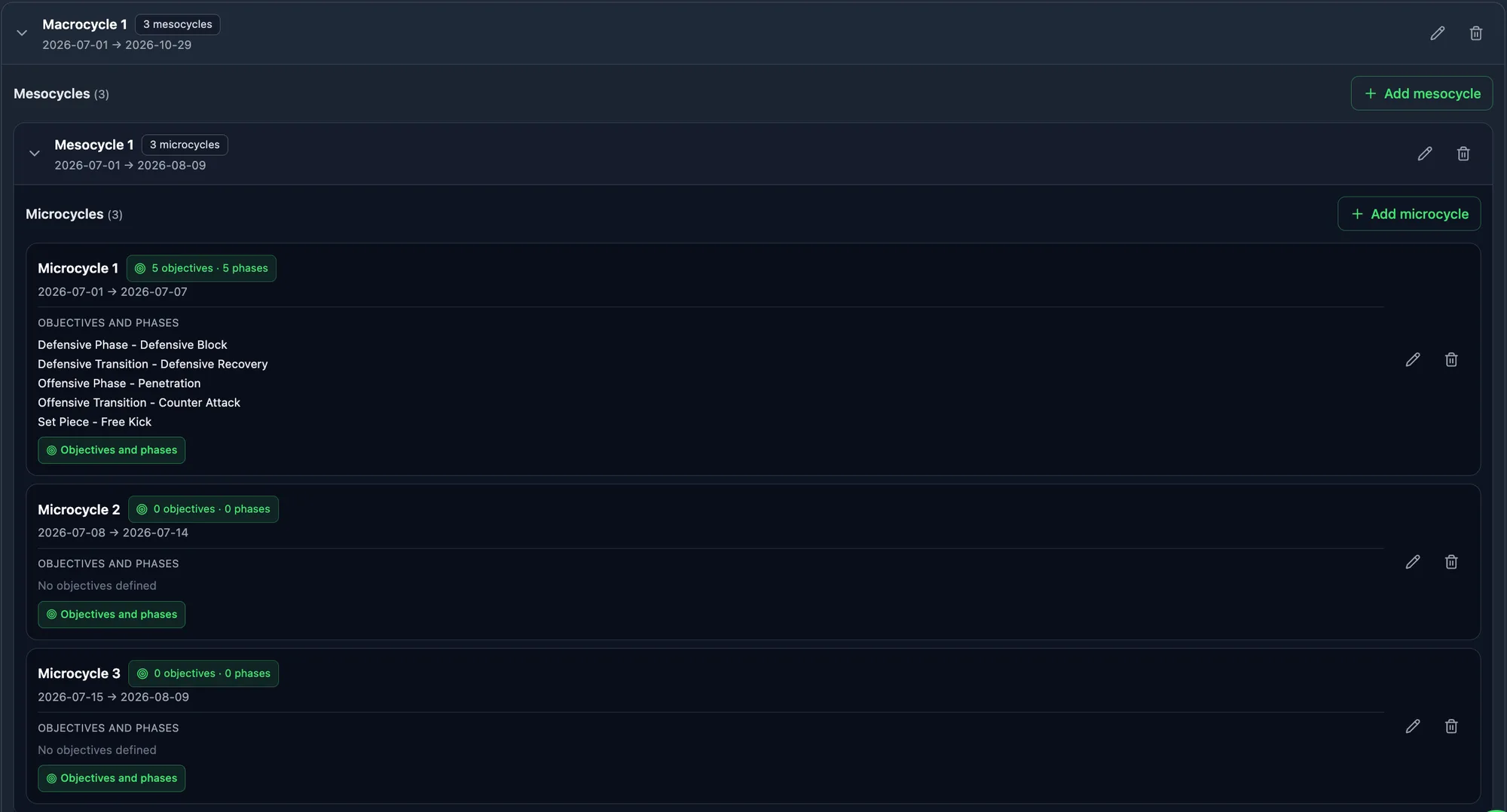
Each team has one methodology per season, built from macrocycles, mesocycles and microcycles. For every microcycle you pick objectives from a catalogue of tactical contents organised by game phase — for example “Attacking organisation · Build-up play” or “Attack-to-defence transition · Counter-pressing” — and assign the week’s sessions from your library.
Each training event is automatically assigned to its microcycle, mesocycle and macrocycle according to its date. You can therefore review the work by block without manually reclassifying every training event.
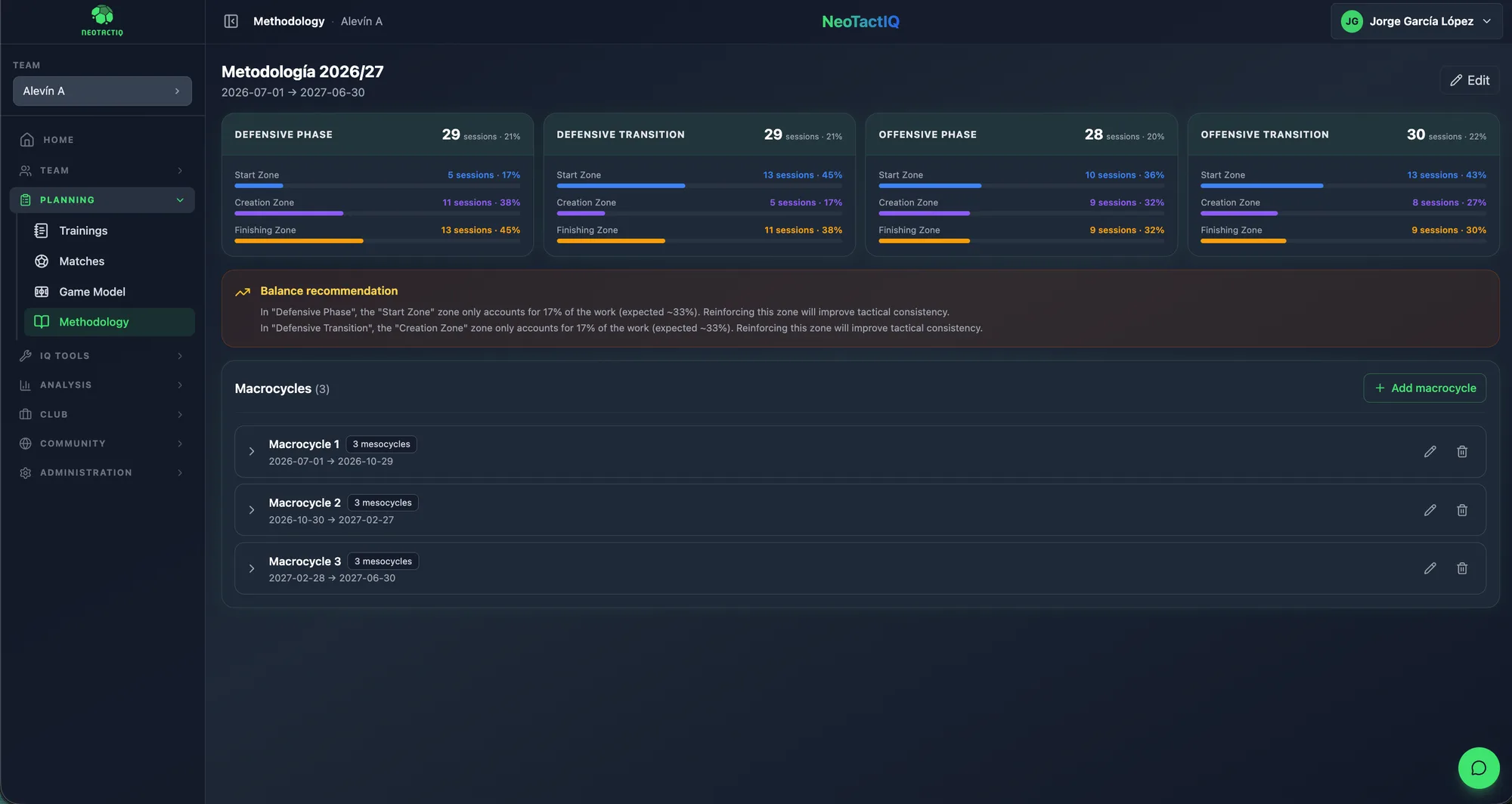
The methodology panel counts training sessions by game phase — attacking organisation, defensive organisation and both transitions — and, inside each phase, by pitch zone: build-up, creation and finishing.
If a zone falls behind, NeoTactIQ flags it with a balance recommendation. For example: “In Attack-to-defence transition, the build-up zone only has 17% of the work (expected ~33%)”. You spot the imbalance while there is still time to fix it.
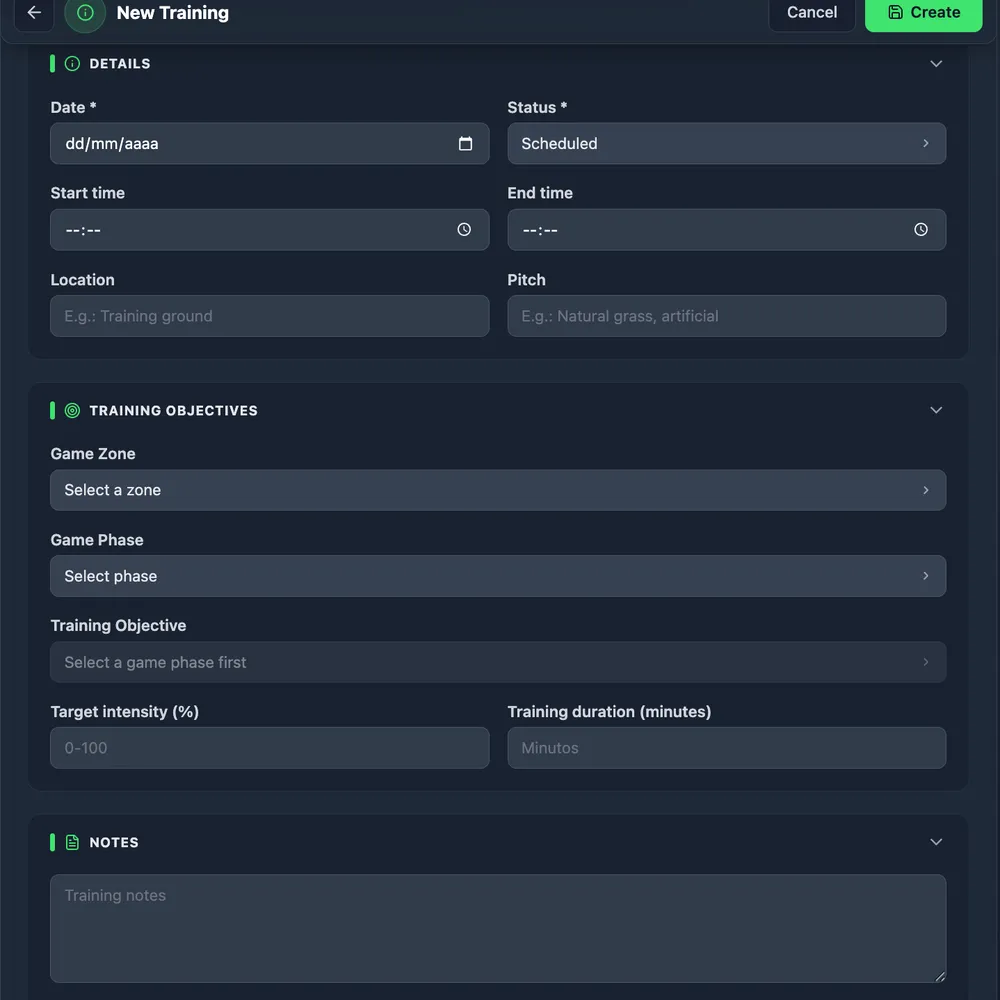
Each training event keeps the information needed to place the work inside the week: date, time, location, pitch surface, phase, zone, objective and target intensity. You can link a session from your library or add individual drills, attach PDF documents and download the training sheet for the rest of the staff.
Afterwards, you take attendance with codes — present, excused absence, unexcused absence, injury, illness or moved up an age group — and that record stays with each player’s follow-up.
The call-up is built on a graphic pitch with the formation you choose: you mark the squad, starters and shirt numbers, note the reason for every player left out, and NeoTactIQ warns you when a player is placed out of position. Counters respect the competition limits, and you can call up a player from another club team just for that match.
Once the call-up is ready, the match plan brings together the opponent analysis — saved with that opponent for the next meeting — instructions by phase and by line with your starters already placed, set plays and the keys to the match, in a PDF for the team talk.
During the match you record goals with their origin, assists, shots, duels, fouls, cards, corners, saves and substitutions. NeoTactIQ builds the timeline with the exact minute and calculates team and player statistics from what was recorded.
With Coach Pro, that record feeds the match report. Its conclusions end in one to three objectives for the following week, which are proposed in the next microcycle of the methodology: your analysis directly shapes what you train.
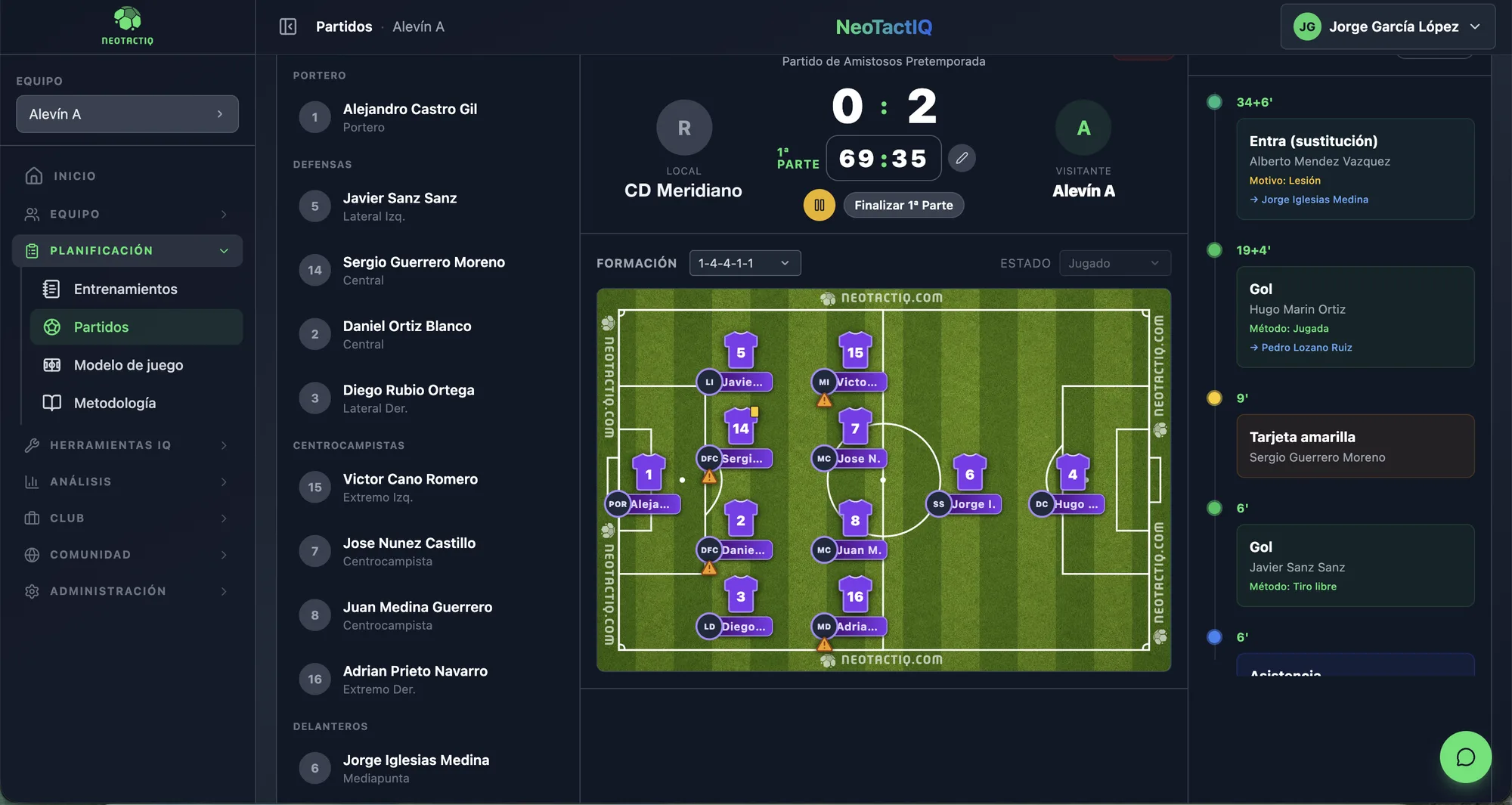
One methodology per season and team, organised into macrocycles, mesocycles and microcycles. Objectives and sessions for each microcycle, a panel of work by phase and zone, and a balance recommendation when something falls behind.
Each training event with its date, location, phase, zone, objective and target intensity, the linked session, attached documents and player attendance with codes.
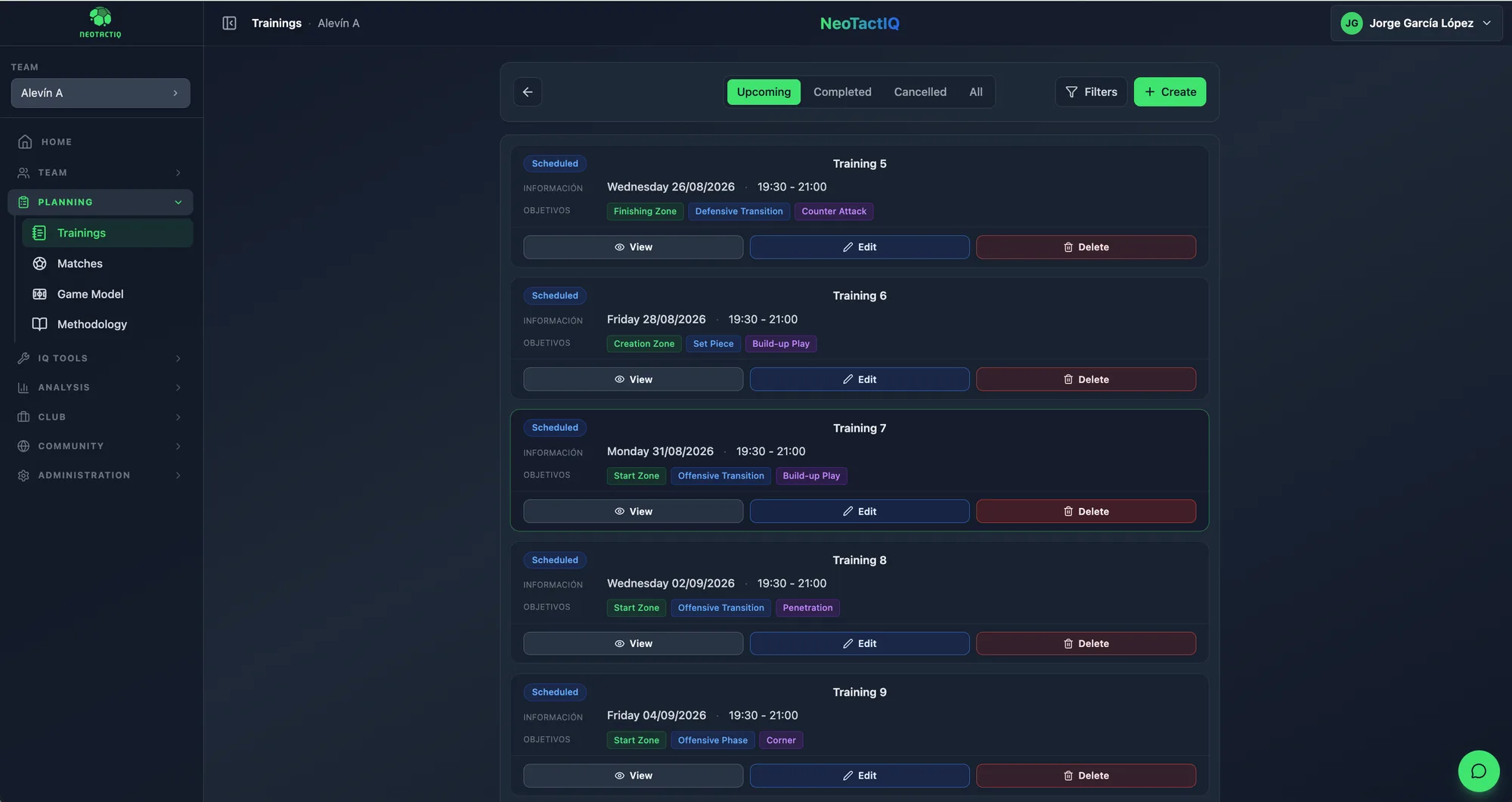
A visual call-up with formation, reasons for leaving players out and position warnings; a live match view with a clock and event logging that calculates the statistics with no extra work.
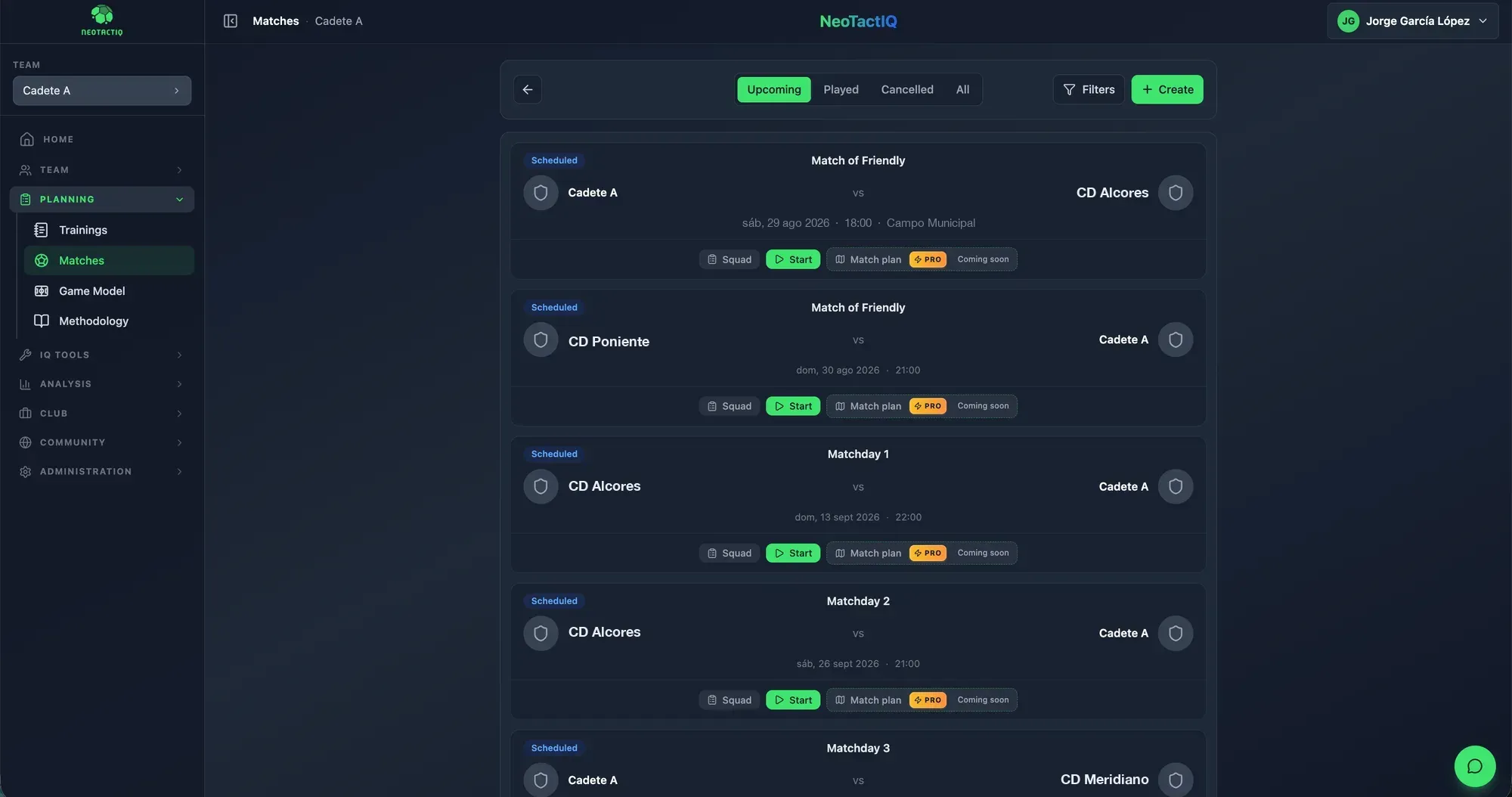
Opponent analysis saved for the next meeting, instructions by phase and by line, set plays, objectives and keys to the match, built on the call-up and exportable to PDF. Included in Coach Pro and Club.
When you coordinate several teams, the question is not only what each coach planned. You need to check what was actually worked on and review it inside comparable periods.
NeoTactIQ lets you review the work with the context of macrocycles, mesocycles and microcycles. With the viewer role you can consult each team’s methodology and training without editing it, see how work is distributed across phases and zones and detect imbalances without relying on each coaching staff to prepare a different document.
Coordinate with evidence, not by chasing files.
If you are a coach, the Coach plan includes methodology, training and matches; Coach Pro adds match plans and match reports.
If you represent a club and need to coordinate work across several teams, we can show you how NeoTactIQ fits your structure.