
Does NeoTactIQ work for an academy with different football formats?
Yes. Each team is set up with its format — 11, 8 or 7-a-side — inside its own context, and competitions apply their own squad and starting limits.
Organise every age group inside a shared club structure without erasing the identity of each team. Format, staff, competitions, methodology and seasons stay connected so the youth setup can grow without depending on isolated files or on knowledge held by people who may only stay for one season.
Youth football brings many realities together at the same time. One team plays a federated league. Another also enters tournaments. Some age groups play 11-a-side, others 8-a-side or 7-a-side. Coaches have limited time and may change from one season to the next.
The problem begins when every team solves its daily work with separate files and its own structure. The academy coordinator ends up asking where each roster lives, who has access, which competition belongs to which group or what methodological work has been recorded. When someone leaves, part of that context can leave with them.
NeoTactIQ treats the youth setup as a club structure: separate teams, people with clear roles, competitions configured in context and seasons that remain available over time.
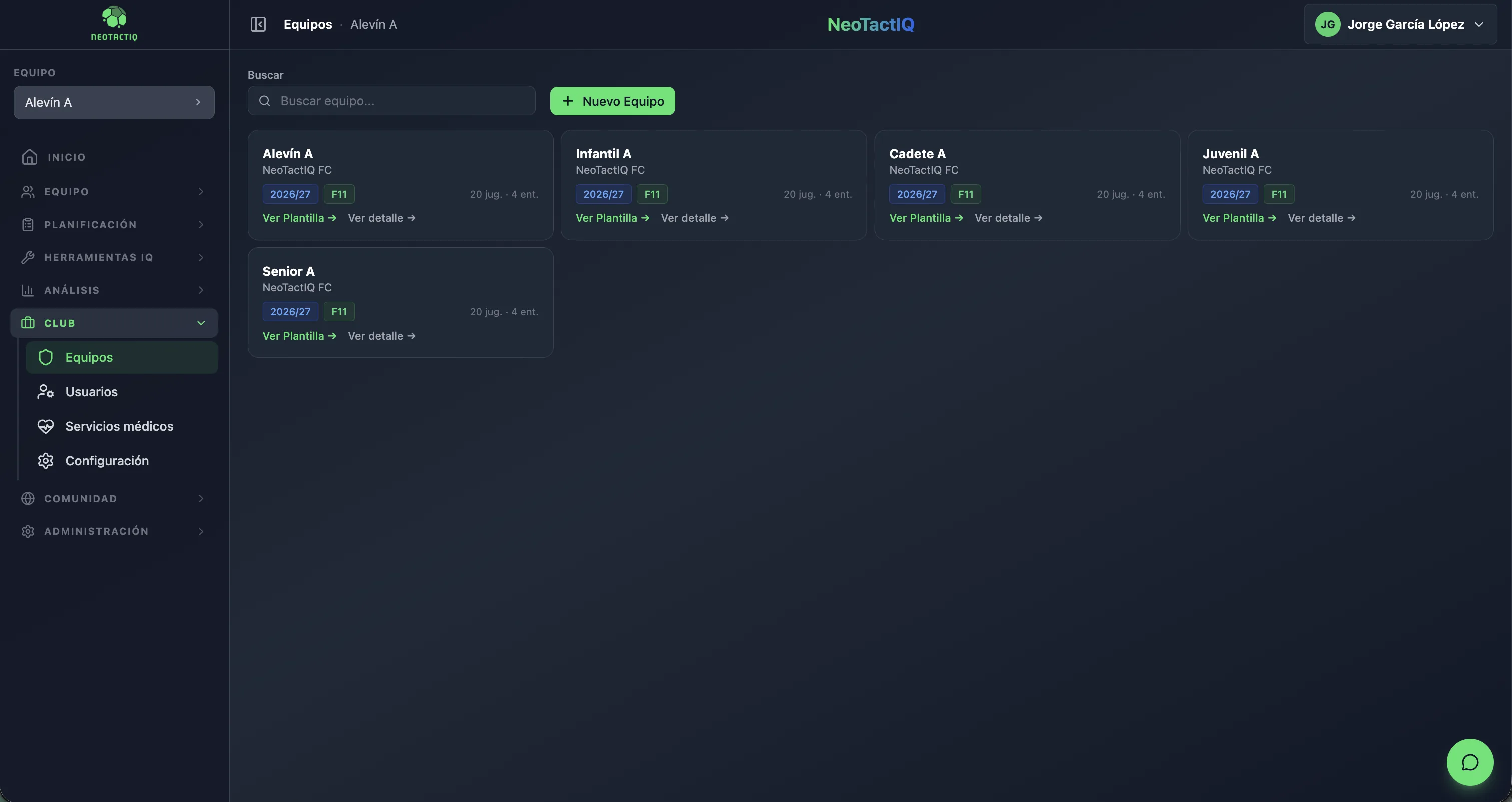
The structure starts with a basic question: which teams actually make up the academy?
NeoTactIQ lets the club create and configure every team with its format — 11, 8 or 7-a-side —, linked roster and assigned staff. That makes it possible to represent different age groups without turning them into one generic list. On the roster, players who are over-age for their age group are flagged automatically from their birth year.
Beyond teams, the club can create specific groups — goalkeepers, skills training — with players from several age groups and their coach; when you add a team, its goalkeepers are flagged automatically.
Each team keeps its own working context. Coordinators can enter a specific category when they need to supervise it, while coaches work inside the team they are responsible for. The aim is not to merge all teams into one aggregated dashboard: the logic is to maintain one common structure and then move into the context of each age group.
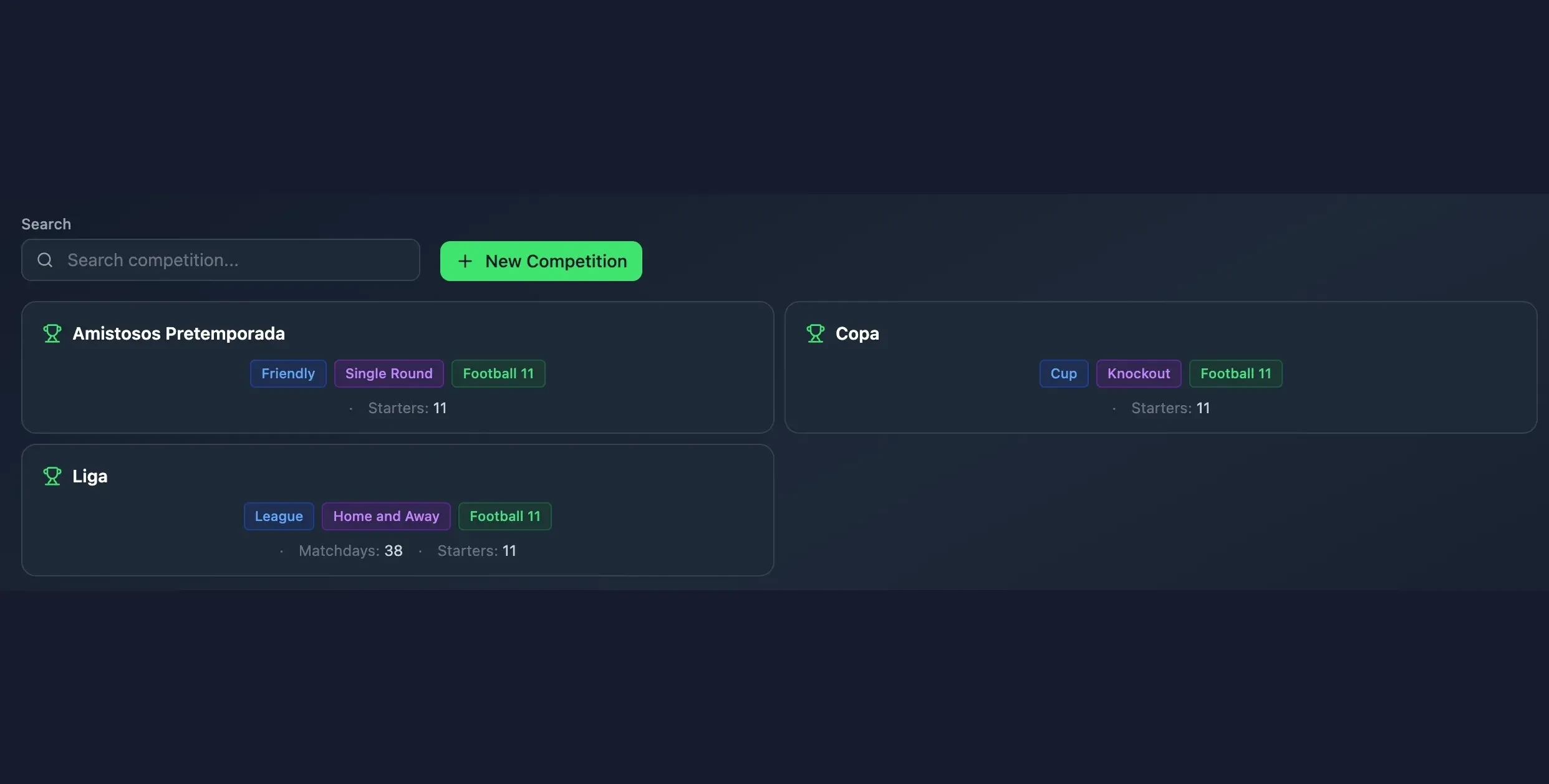
Youth teams often compete in several contexts during the same season. One age group may play an official league while also entering a tournament with different rules. Those conditions should not have to be rebuilt before every game.
Rule inheritance means every game starts from the competition framework already connected to its league, cup or tournament. A team can therefore handle several competitions at once without asking the coaching staff to remember manually which format applies every weekend.
Configure each competition once — format, squad size, periods, extra time and penalties — and NeoTactIQ applies those rules to all of its matches.
A youth academy needs a shared direction, but it does not need every coach to work in exactly the same way.
NeoTactIQ organises each team's methodology by cycles in a language shared across the academy: the same phases of play, tactical objectives, pitch zones and drill types. Sporting management and coordinators can review that structure team by team while each coaching staff still makes its own football decisions.
That view does not create automatic comparisons between age groups and does not tell each coach how to train. It helps the club review the work recorded inside each team’s own context and see whether planning reflects the development direction the organisation wants to maintain. The purpose is to make the methodology reviewable without turning it into a rigid template that removes coaching responsibility.
It shows how work is distributed by phases and zones and detects imbalances.
The individual report adapts to the player’s stage — foundation (up to 12), development (13 to 16) and performance (17 and over) — and rates each block against what is expected for that stage, on four levels described in words: beginning, in progress, achieved and stands out. It never compares the player with teammates.
The period’s data fills in on its own — call-ups, minutes, goals and training attendance — and the internal section flags the relative age effect so physical maturity is not mistaken for talent. The coach sets 2 or 3 concrete objectives, each with what the club will do to help.
From age 13, players can complete a self-assessment through a personal link, with no account needed, and the coach sees it next to their own assessment. The family version comes out as a PDF with strengths, objectives and what the player can do on their own, without internal or health data. Individual reports are included in Coach Pro and Club.
A family report, as a PDF and in words, with no scores or health data.
Attendance is taken at every session with codes: A (attended), FJ (excused absence), FN (unexcused absence), L (injury), E (illness) and SC (moved up an age group). Attendance flows straight into each player’s individual report.
Moving up also leaves a trail: the SC code in attendance, the “Promoted” status on the player profile and the option to call up a player from another club team for one match only — they join as a substitute tagged with their team and stay on their own roster — or to add them to another club roster.
Coaching turnover is normal in youth football. Starting from zero every time should not be.
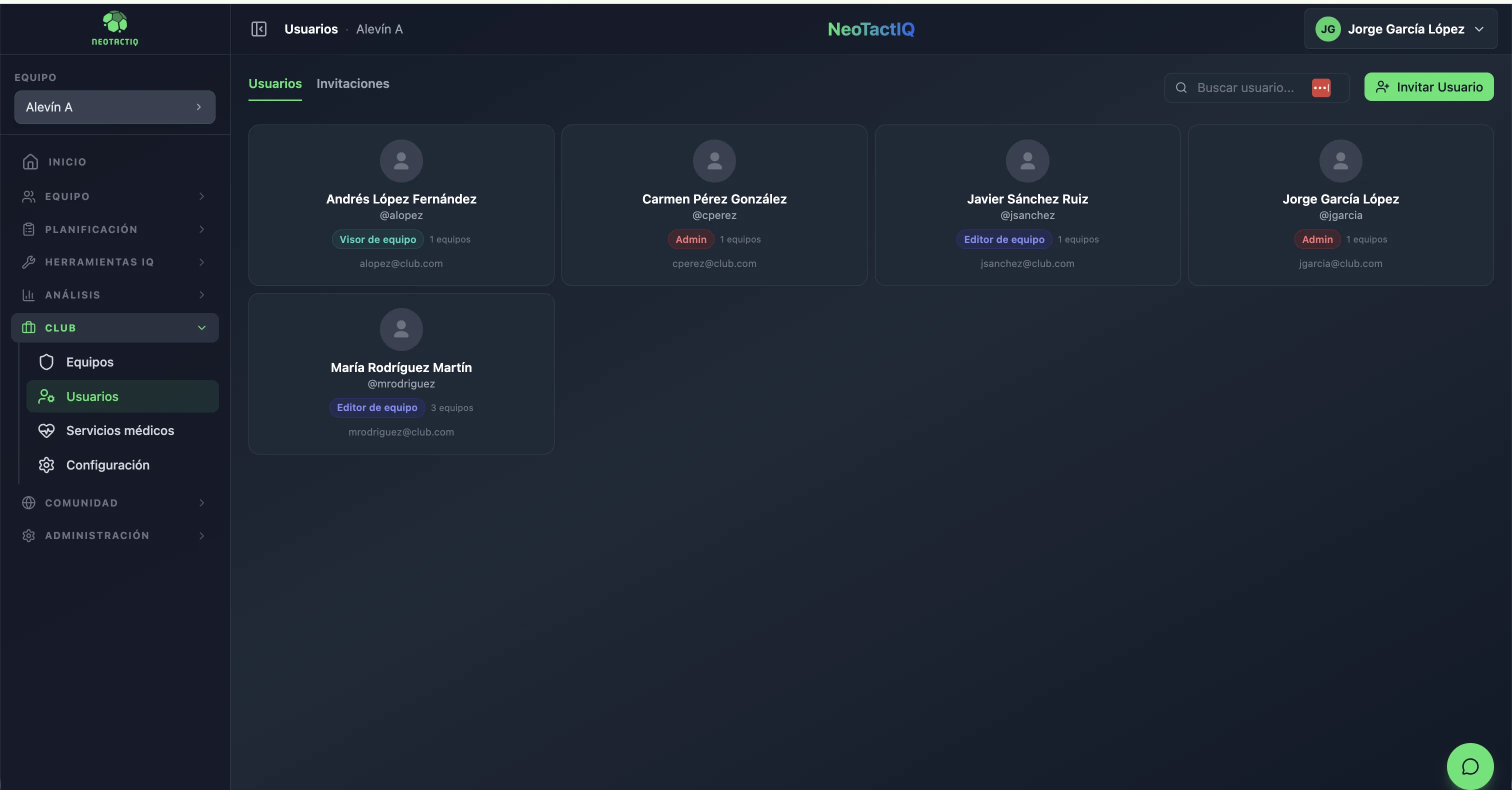
NeoTactIQ uses three roles: Admin / Team Editor / Team Viewer. A coach can work inside the assigned team, while a coordinator can supervise with read-only access where appropriate. When someone leaves the club, their access can be revoked without turning the staffing change into the loss of work already recorded.
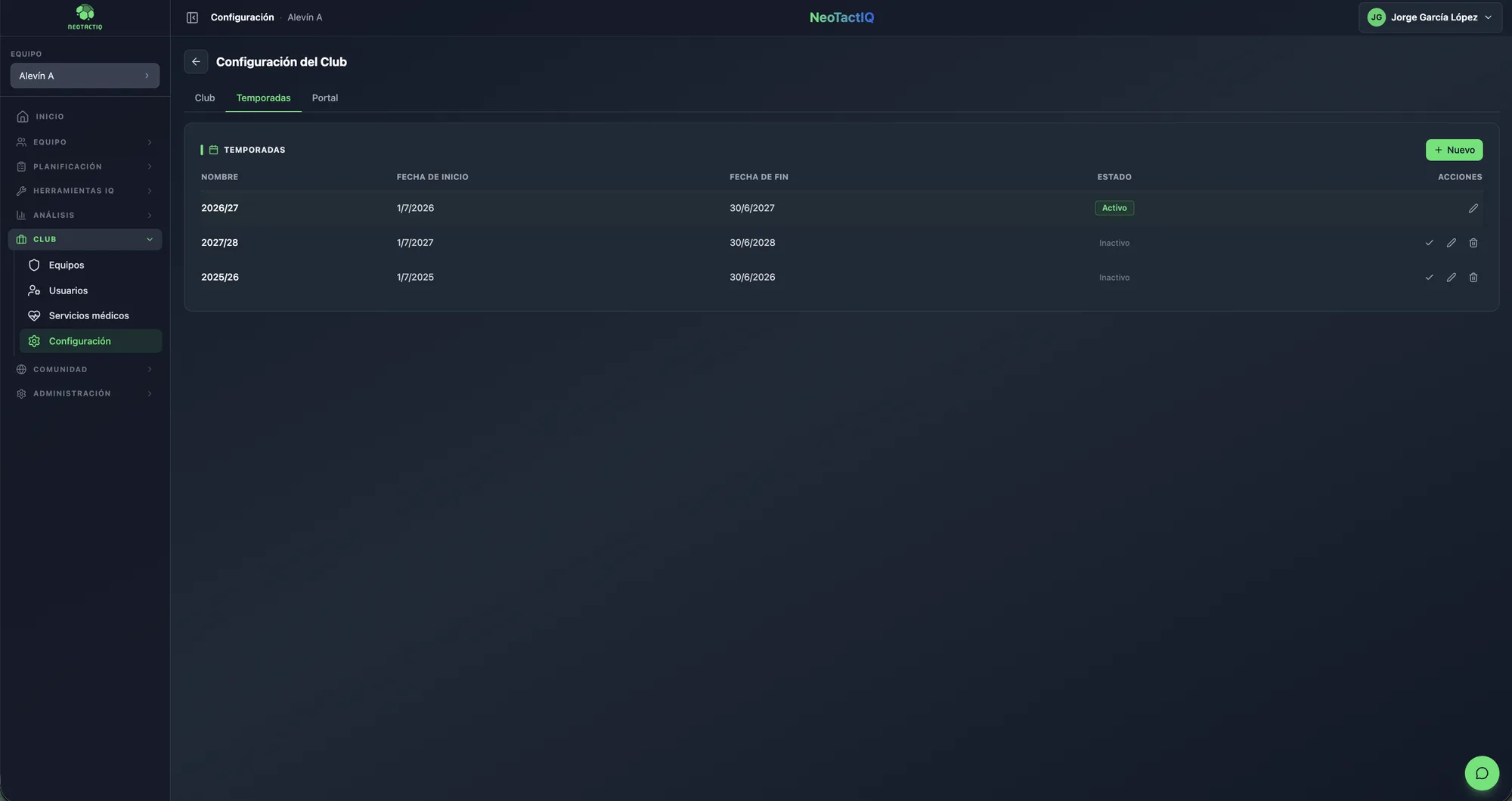
Continuity also carries across seasons. Close the season and keep the history: the club does not start from zero every year. This page does not specify the exact fields retained: the promise is institutional — the season remains part of the club’s history.
Each person in the club accesses the platform with their own role: administration, team editing or read-only access.
Moving to a common structure should not require every coach to rebuild everything they already have.
If an age group already has its roster in Excel, it can import that roster when getting started and continue working from NeoTactIQ afterwards. From there, each coach can begin with one concrete need: the tactical board is free forever, with no credit card required, so the first useful step can be as practical as drawing and animating a drill, exporting it as an image or video, or saving their first 3 drills and 3 set plays.
Adoption does not need to begin with every area at once. The club can organise its wider structure while each coach starts using NeoTactIQ through something that is genuinely useful during the week.
Yes. Each team is set up with its format — 11, 8 or 7-a-side — inside its own context, and competitions apply their own squad and starting limits.
Yes. Each competition keeps its own configuration, and linked matches automatically inherit those rules.
The person's access can be revoked. Work already stored in NeoTactIQ remains inside the club structure, and previous seasons can continue to be consulted as history.
Yes. Attendance is taken player by player at every session with codes (attended, excused absence, unexcused absence, injury, illness and moved up an age group), and that record appears in the individual report.
With Coach Pro and Club, the individual report has a family version as a PDF, with no internal or health data, and players aged 13 and over can complete a self-assessment through a personal link, with no account needed. NeoTactIQ does not include messaging with families or fee collection: day-to-day communication stays on the club’s own channels.
Teams by age group, competitions with their own rules, clear roles, reviewable methodology, attendance, stage-based reports and seasons that remain. One shared base so the club can preserve continuity even when coaches change.